Logarithmic-Spiral Method
In using the friction circle method or the method of slices, the distribution of forces along the failure arc or on both sides of a slice must be assumed arbitrarily.
This diffi culty can be overcome if a logarithmic spiral is used as a failure surface. No matter what the magnitude of normal forces on the failure surface may be, the property of the logarithmic spiral is such that the resultant of the normal and frictional forces always will pass through the origin of the spiral. Consequently, when a moment is taken about the origin, the combined effect of normal andfrictional forces is nil, and only the weight and cohesion moments need to be considered. This logarithmic-spiral method was fi rst suggested by Taylor (1937) for stability analysis.
Fundamental Principles and Advantages
Logarithmic Spiral Equation
The equation of a logarithmic spiral in polar coordinates is expressed as: r = ro e(θ * tan φ)
Where:
The origin of the logarithmic spiral is located by means of two arbitrary angles, t and z.
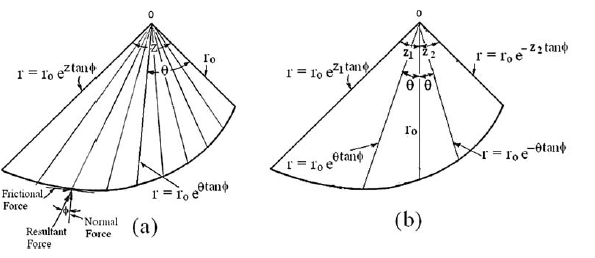
When using the friction circle method or the method of slices, the distribution of forces along the failure arc or on the sides of a slice must be assumed arbitrarily. This difficulty can be overcome if a logarithmic spiral is used as the failure surface.
Regardless of the magnitude of the normal forces on the failure surface, a key property of the logarithmic spiral is that the resultant of the normal and frictional forces always passes through the origin of the spiral. Consequently, when calculating the moment about the origin, the combined effect of the normal and frictional forces is zero, and only the moments due to weight and cohesion need to be considered. This logarithmic spiral method was first proposed by Taylor (1937) for stability analysis.
How to Set Up a Logarithmic Spiral Slip Surface in Slope